
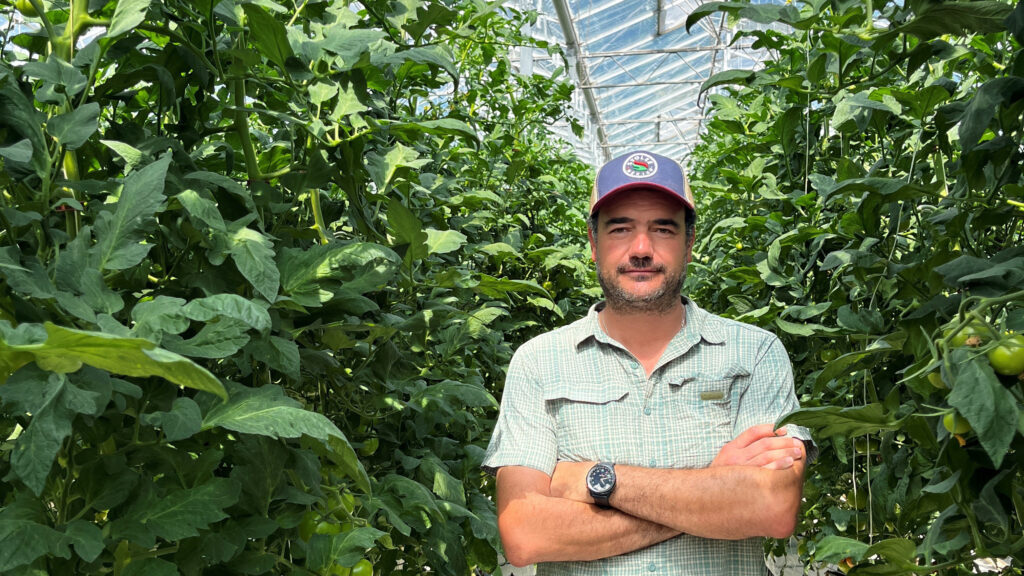
Manuel Valdes Lara is an agronomist and owner-partner at Bresca Hortalizas. With 17 years of experience in the greenhouse industry, he supports growers across Mexico and beyond. In this interview, he explains why irrigation has become a high-pressure daily challenge, and why autonomous climate & irrigation control is a logical next step.
Irrigation used to be handled with rules of thumb and a quick check of yesterday’s numbers. In Mexico, that is no longer enough. Resources are costly, water is scarce, and weather can push plants to the edge. The margin for error is small.
Daily operations: sampling, checking, adjusting
“A lot of information is available, but time is not,” says Manuel. “Manual sampling and spreadsheets leave room for error. Then you spend hours validating numbers and changing settings as conditions shift. It becomes guessing and firefighting.”
For many growers, the morning starts with dripper and drainage samples across several slabs to understand what goes in and what comes out. Those readings drive decisions on shot size and interval. Yet the plant buffer is limited. Sun, clouds, humidity, and VPD change throughout the day. Forecasts help, but not enough to avoid constant adjustments. Teams end up behind a screen when they would rather focus on crop quality and people.
Manuel sees a clear pattern across operations. “We used to say: a little more water is safer than a little less. Today that extra bit is real money,” he says. “There is plenty of data. The problem is time, and the risk of human error.”
What autonomous control delivers in practice
With Crop Controller, the grower sets the targets and strategy. The system continuously reads current conditions and uses that information to execute the strategy consistently throughout the day. That includes irrigation timing, shot size, start and stop, plus the climate actions that support uptake and dry‑down.
“You define the strategy and the system handles execution,” Manuel says. “Fewer corrections, more predictable days.” In practice, he has seen it suggest lower heating when the target temperature was already achieved. The outcome is the same strategy, delivered with more consistency and efficiency.
A more strategic role for the grower
Manuel emphasizes that the grower stays in charge. “This is not a replacement,” he says. “The tool learns from you and executes within your parameters.”
That matters for training and continuity. Teaching new staff to “guess better” takes years and will always be prone to variability. When execution is reliable, knowledge sharing can shift towards coaching, planning, and crop work on the floor.
Integrated climate and irrigation control
Irrigation and climate belong together. Plants drink on microclimate, not sunlight alone. Humidity, VPD, and temperature drive uptake and drydown. “We were among the first users to push for autonomous irrigation in Mexico,” Manuel explains. “We could see how tightly irrigation connects to climate. You cannot optimize one without the other.” Integrated steering brings a stable root zone and fewer midday interventions. The day becomes calmer and easier to plan.
Timing: Why early adoption matters
Why adopt now rather than later? Manuel’s view is direct. “Senior growers should embed their strategy in tools that can execute and be handed over. Waiting will not make weather simpler or labor management easier. It only delays the benefits.”
Stability and predictability are now part of yield. If you want to move from daily corrections to consistent execution of your own strategy, discover how Crop Controller delivers autonomous climate & irrigation control in your greenhouse and request a demonstration from our team