
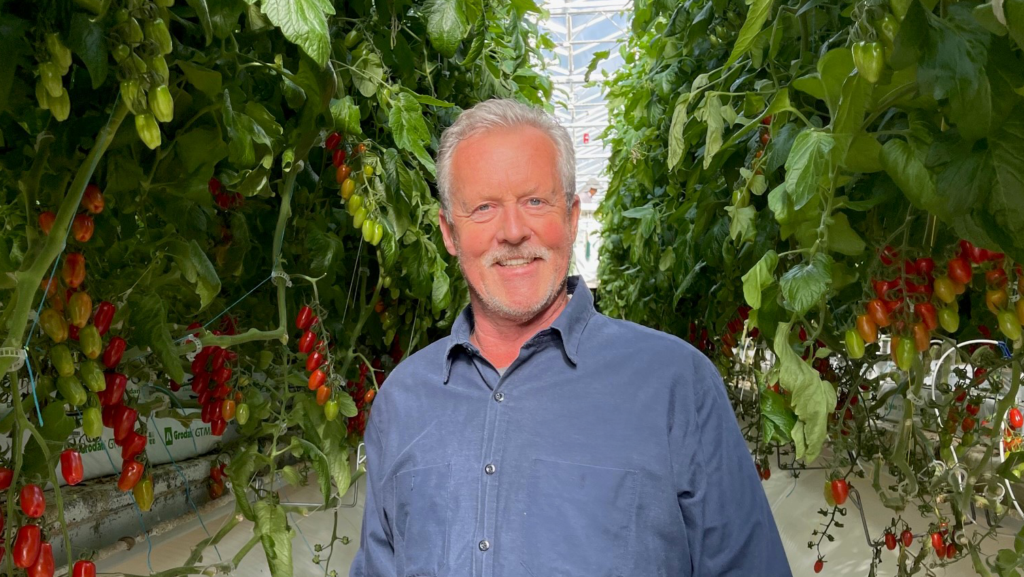
In a recent interview, Arie van der Giessen shared a candid view on the realities of modern greenhouse growing. With decades of experience across international, large-scale operations, he has worked with multiple teams, crops and locations. That breadth of experience gives him a clear perspective on one of the industry’s biggest challenges today: managing increasing complexity while maintaining consistency.
Modern greenhouse horticulture is no longer just about growing plants. It has become, in Arie’s words, top sport. “We’ve tripled or quadrupled what’s in our daily workload,” he explains. “There are so many more factors to manage, and every aspect has to be right.”
That growing complexity is especially visible in irrigation and climate control. Decisions must be made continuously, often under pressure and based on multiple data sources. But according to Arie, the real challenge is not technical capability. It is human attention. “Every day, you have moments where attention drops,” he says. “Late afternoon, people want to go home. That’s when mistakes happen.”
Small inconsistencies can quietly affect plant performance
Those mistakes are rarely dramatic. Instead, they appear as small inconsistencies that quietly affect plant performance. “Too wet, too dry. Those fluctuations shouldn’t be there,” Arie explains. “You want stability. But in practice, you see these fluctuations happen all the time.” A missed irrigation moment or a delayed climate response to changing weather creates subtle stress. “You can correct it the next day,” he adds, “but you’re always correcting. You’re always behind.”
For Arie, this constant correction cycle exposes a limitation of manual control in increasingly complex environments. “If a plant is just a bit short of water at the wrong moment, you lose growth energy,” he says. “It may seem small, but it adds up. If you make fewer mistakes, you get top production.”
Growers agree on the fundamentals, but execution differs
The issue becomes even more complex in multi-site operations. Having worked across different locations and teams, Arie has seen how subjective decision-making leads to variation. “Everyone more or less makes the same kinds of mistakes,” he says. “But everyone also does things differently. Twenty growers means twenty opinions.”
Even when growers agree on the fundamentals, execution still differs. “We all know certain basics. After the third irrigation, you want some drainage. That’s not new,” Arie explains. “But still, everyone applies it differently.” Some growers accept daily fluctuations as normal, while others aim for strict consistency. “I can’t accept it when one day the drain graph looks completely different from the next. Then something in the execution has changed.”
Another pattern Arie often sees is over‑adjustment. “Growers keep changing the climate settings,” he says. “But sometimes it takes two or three days before you see the effect. If you keep adjusting, you don’t even know what actually worked.” In larger organizations, this has led to limits on how often settings can be changed, simply to reduce noise.
Staying on course, regardless of outside conditions
It is exactly this type of challenge that has driven the development of autonomous climate and irrigation control systems in the industry. Rather than reacting after deviations occur, these systems aim to execute a predefined strategy consistently throughout the day. Solutions such as Crop Controller illustrate how growers can reduce variation in execution without removing their own strategic input.
Autonomous control directly leads to consistency
What matters most to Arie is the effect on stability. “Autonomous control gives you consistency,” he says. “Then you can focus on strategy instead of fixing yesterday.” Growers decide how they want the crop to perform, while the system supports continuous execution of that intent.
Arie also stresses that irrigation and climate control should never be treated separately. “It’s all one system,” he explains. “One and one becomes three. It’s about how you want to grow and what level of production and quality you’re aiming for.” When these elements work together, the growing process becomes more predictable across different days and locations.
This integrated approach also helps organizations retain knowledge. “Even if people change, your way of growing stays the same,” Arie says. Consistent execution makes it easier to compare sites, fine‑tune strategies and improve results over time.
At the same time, autonomous control creates room. “There are so many other things that need attention,” Arie says, referring to plant health, labor and biology. “If you’re always busy with the climate computer, you don’t get to those things. And that’s where real value sits.”
Approach your day with more focus and control
Looking back, Arie reflects on the mental load of manual control. “If I didn’t irrigate properly in the evening, I couldn’t sleep. I was always checking.” Reducing that constant pressure allows growers to approach their work with more focus.
For Arie, the direction is clear. “This is the future,” he concludes. “Not because it replaces people, but because it helps them do better.” As greenhouse operations continue to scale and complexity increases, autonomous climate and irrigation control is becoming a practical way to keep growing strategies aligned across people, places and time.