
Managing greenhouse climate and irrigation is becoming increasingly complex. Higher energy prices, labor scarcity and sustainability expectations make manual steering less logical, every day. Each decision impacts crop development, energy and water use, and the workload on the grower’s entire team.
In many greenhouses, steering still happens manually and often reactively, which makes it difficult to maintain a stable rhythm throughout the day.
Crop Controller brings autonomous climate & irrigation control, strategic crop planning and expert support together in one integrated system. The goal is simple: fewer corrections, more consistency and a greenhouse that behaves in line with the grower’s intentions.
Why climate and irrigation decisions need to be managed together
In the greenhouse, every action is connected; nothing operates in isolation. Irrigation influences humidity; humidity affects temperature control; temperature changes plant activity and water demand; CO₂ and radiation steer assimilation and transpiration.
When these factors are steered manually and reactively, growers often end up correcting one adjustment with another. Crop Controller prevents this by constantly updating climate and irrigation settings based on real‑time data, weather forecasts, and crop behavior.
The result is practical: fewer reactive corrections and more consistent execution of the grower’s crop strategy.
All four modules explained, including expert support and knowledge
We see climate and irrigation as the core of greenhouse operations. That’s why we position Crop Controller as an integrated service, not a collection of separate software components growers have to stitch together.
Any autonomous solution that influences the climate and irrigation must behave reliably, offer transparent insights and support the grower instead of adding uncertainty. This philosophy shapes how the four modules work together:
- Autonomous climate control | Crop Controller maintains a stable climate by planning assimilation lighting, managing temperature with RTR, controlling humidity and adjusting setpoints for heating, ventilation and energy screens. It anticipates changing weather conditions, so the greenhouse stays consistent without continuous manual adjustments by the grower, while executing the strategy of the grower.
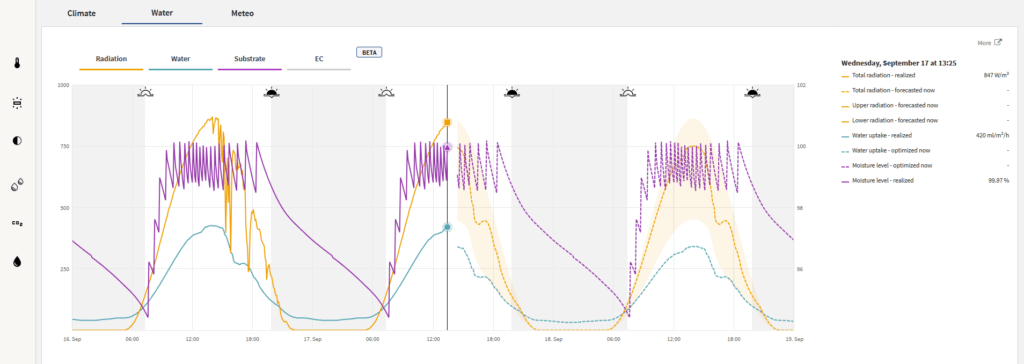
- Autonomous irrigation control | Irrigation is steered around actual plant demand. The system tracks water uptake, drain, EC and substrate drying, including data from weighing scales, and calculates the right setpoints for the climate computer. Crop Controller simulates the moment and volume for each shot, for the coming days. This creates a predictable irrigation rhythm that supports crop balance throughout the day.
- Strategy optimization | Strategy optimization keeps daily decisions aligned with long‑term crop goals. It generates a crop and climate plan, tracks the plant energy balance and uses weekly crop registration to update forecasts. By combining real‑time data with planned objectives, it shows where the crop is heading and helps growers make timely strategic adjustments.
- Personal support | Each grower works with a dedicated Autonomous Greenhouse Manager, with crop knowledge, who monitors performance and results, provides regular guidance and shares quality insights. With chat support and access to the ‘Knowledge Hub’, growers are never left alone in the process of adopting and using autonomous control.
Renewed power in the role of grower
Autonomy is sometimes misunderstood as a hands‑off approach or a loss of influence, but that is not how Crop Controller works. The system acts as a virtual operator that thinks along with growers, anticipates changing conditions and responds instantly. The grower’s unique crop strategy remains the foundation for every decision.
Growers always have insight into what the system is doing and why it is doing it. They can adjust objectives whenever their strategy evolves, and they can intervene at any moment if circumstances require it. The autonomy is there to protect consistency, reduce unnecessary stress, and keep the greenhouse aligned with the grower’s intentions. It supports them instead of taking the grower out of the process.
Who benefits from autonomous climate and irrigation control?
Whether a grower manages one greenhouse or multiple sites, the value of this integrated system becomes clear in daily practice. Larger operations use Crop Controller to steer locations more consistently, reducing variability and giving teams clarity and stability across hectares. Smaller operations benefit from precision and continuity without needing extra labor to keep up with modern greenhouse complexity.
Across 17 countries, growers report:
- Up to 80% fewer manual climate computer actions, freeing time for higher‑value work
- Up to 15% energy savings from more stable and anticipatory climate steering
- 4× More hectares per grower or team without increasing workload
- More predictable irrigation rhythms based on actual plant demand
- Fewer daily corrections, reducing firefighting and interruptions
- Lower mental load and greater confidence that the crop behaves as intended
Crop Controller integrates seamlessly with climate computers such as Priva and Ridder and runs securely on Microsoft Azure. What growers experience is consistent: less firefighting, more crop stability and greater certainty that their strategy is executed as intended, day and night.
One system that keeps operations stable and make them scalable
Ultimately, the strength of Crop Controller lies in how its four modules work together in daily practice. Climate, irrigation, strategy and support are not separate features but parts of a single approach that keeps the greenhouse performing well, predictable and aligned with the grower’s intentions.
When fewer hours are spent correcting settings and more time is available for improving the crop or managing the business, autonomy becomes more than technology. It becomes a practical way to run a greenhouse with greater consistency, efficiency & continuity.