
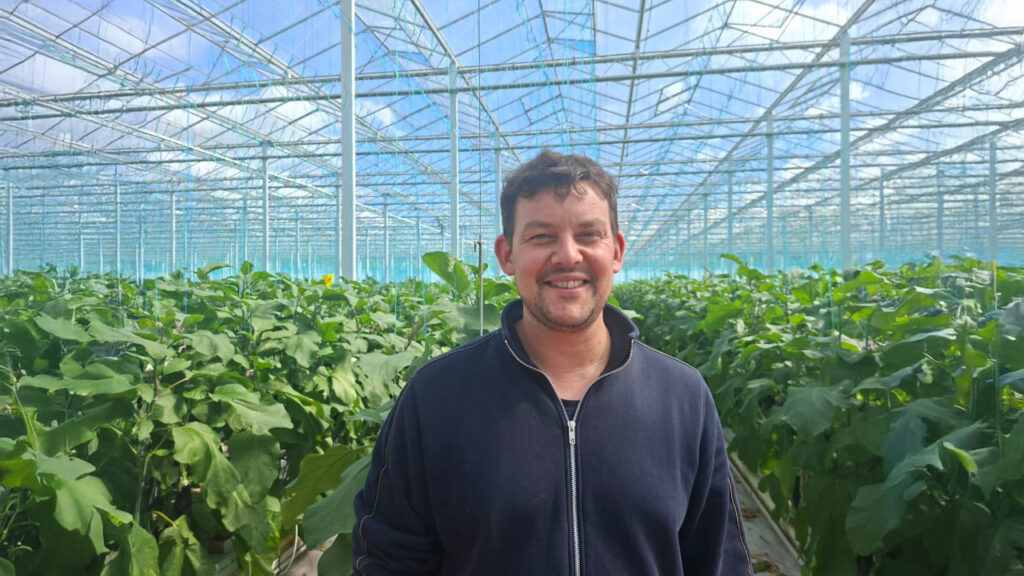
Near Nantes, 33-year-old Benoît Musset runs a modern greenhouse company growing tomatoes, eggplants and cucumbers, SCEA la Plaine. Five years ago, he took over the business from his father. Since then, he has continued to develop the company step by step and has been looking for ways to work more efficiently. In early 2025, he decided to take a new step: autonomous growing with Crop Controller by Blue Radix.
The step toward autonomous growing
Benoît’s company covers 5.5 hectares. Working with just the two of them, they manage 2 hectares of cucumber, 2.5 hectares of tomatoes and 0.9 hectares of eggplants. Benoît is fully responsible for daily climate control. This means he constantly has to make decisions about ventilation, temperature, screen usage, and moisture balance. “When you’re the only person responsible for the climate, you have to be everywhere at once,” he says. “You’re constantly checking settings and data. That takes a lot of time.”
He first learned about autonomous growing and Crop Controller by Blue Radix through Divatec, his installation partner. The integration between the Ridder climate computer and Crop Controller enables autonomous control. Crop Controller calculates setpoints on a 5-minute level and sends these calculated setpoints to the climate computer without human interference. The system then steers the greenhouse installations via the climate computer, ensuring precise execution of the grower’s crop strategy. “The idea that the system could follow my strategy and support and take decisions immediately appealed to me.” Since May 2025, Crop Controller has been running at the company.
Crop Controller in brief
Crop Controller optimizes and realizes the grower’s unique strategy. The system operates like a virtual colleague and works 24/7 alongside the grower. It calculates the optimal climate control and irrigation every 5 minutes, forecasting 3 days ahead. This gives the grower more control and efficiency. With the combination of autonomous climate and irrigation control, the grower saves about 80% of the climate computer work.
Getting used to a new way of working
Autonomous growing also means the grower’s role changes. Instead of manually adjusting every parameter, the grower sets strategies and lets the system execute and optimize them. According to Benoît, this requires a different way of thinking. “It’s a bit like driving an automatic car,” he says. “You’re used to shifting gears manually, and suddenly the car does it for you. You need some time to adapt.” He used the initial period to better understand the system and learn how Crop Controller works. “You need to observe and understand what the system does,” he explains. “That takes a bit of time. But after a few weeks, you start to trust it.”
Less Time Behind the Computer
The biggest change in his daily work is the time savings. “Each day, I spend about an hour less on the climate computer,” says Benoît. “That may not sound like much, but over a week or a season it’s huge.” He can now spend that time in other ways. “I can spend more time observing in the greenhouse and doing other tasks. This makes my work more efficient.” The real-time insights through the portal also contribute to this. “You can see exactly what the system is doing and why,” he says. “That builds trust. You always have a clear overview.”
Collaboration with Blue Radix
When starting out, Benoît worked intensively with Tom, his personal Autonomous Greenhouse Manager at Blue Radix. The initial focus was on entering the correct data and making sure the system was set up properly. “You have to feed the system the right data,” he explains. “I needed help with that because I didn’t know the system yet.” According to Benoît, the collaboration is truly a partnership. “In the beginning there’s a lot of communication. After that, the focus shifts to monitoring and discussing results.”
Rapid Scaling
Less than four months after starting, Benoît decided to expand the area under autonomous climate control from 2 hectares to 5.5 hectares. For him, it was a logical step. “I understood how the system works and saw the benefits,” he says. “Then I thought: why not expand?” Besides the time savings, he also sees other benefits in climate control, such as ventilation. “Opening the windows and removing heat is controlled very precisely,” he explains. “That helps keep the climate stable.”
Looking Ahead
Crop Controller was also introduced to the tomato and eggplant crops in February. They are currently working on configuring and optimizing the energy screens. Benoît also considers autonomous control for future investments. “If I build or purchase a new greenhouse, I would integrate Crop Controller right away,” he says. “Normally it takes about three years to really understand a greenhouse. With a system like this, you can greatly speed up that process.”
Advice for Other Growers
For many French growers, autonomous growing is still relatively new. Benoît notices that growers often look to each other before taking a step themselves. His advice is clear: “Just try it,” he says. “If you have a climate computer, you can start right away.” According to him, the step is less daunting than many growers think. “At first, you might think you’re losing control,” he says. “But via the portal you see exactly what the system does. That actually brings peace of mind.”
Partner integration and collaboration
At Blue Radix, we collaborate with a wide network of partners and dealers who play an important role in bringing autonomous growing technology to growers around the world. For this case study, we want to acknowledge the contribution of Ridder and Divatec, whose involvement supports the overall implementation and integration and helps growers benefit from autonomous climate and irrigation control.